
The Name That Changes Everything
Why the Turkish Republic of Northern Cyprus (TRNC) Should Become the Turkish Republic of Cyprus (TRC)

A strategic declaration of sovereignty, a refusal to play by the enemy's rules, and the final rejection of the fiction that Cyprus is a “Greek island.”
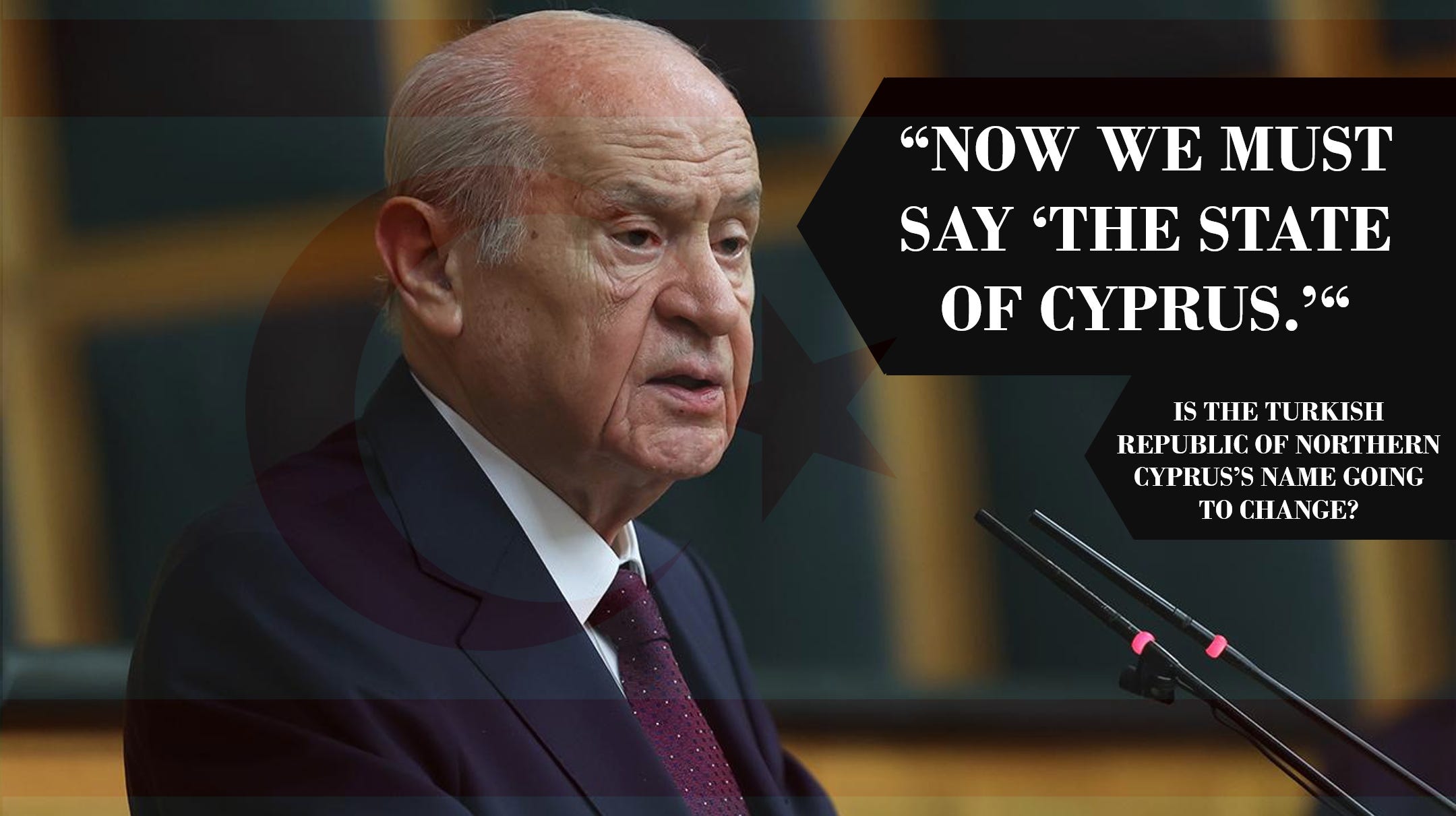
On 1 October 2023, Devlet Bahçeli - described as a “kingmaker” in Turkish politics, the leader of the Nationalist Movement Party (Milliyetçi Hareket Partisi, MHP), and the architect of the People’s Alliance (Cumhur İttifakı) between MHP and the ruling Justice and Development Party (Adalet ve Kalkınma Partisi, AKP) - stood before the Turkish Grand National Assembly (Türkiye Büyük Millet Meclisi, TBMM), the unicameral legislative branch of the Turkish government, and declared:
“There is no longer a need to say the Turkish Republic of Northern Cyprus. It is necessary to say the Cyprus State.” (“Artık Kuzey Kıbrıs Türk Cumhuriyeti demeye gerek yok. Kıbrıs Devleti demek gerek.”)
This was not a semantic shift. It was not a rhetorical flourish. It was a strategic declaration of sovereignty - a refusal to play by the rules of a game that has been rigged for centuries.
For over fifty years, the Turkish Cypriot people have been forced to defend the legitimacy of their state against an international order that refuses to accept it.
For the decade prior, they were forced to accept a legal fiction of state continuity while their men, women and children were being slaughtered by the rump that was treated as the “government” of that “state” - in a campaign the UN termed a “veritable siege” aimed at “the subjugation, if not extermination” of their people.
For eighty… no… one-hundred-and-forty-years, they were the choice target of a policy to systematically “make Cyprus Greek by migration and taxes” accompanied by “the destruction of Mosques and Turkish cemeteries.”
They have been forced to play by rules written by their adversaries while they were systematically appropriated out of their lands and savagely brutalized out of political relevance and existence.
They have been told that their state - just like all the entities leading up to it, their entire history of self-governance necessitated by existential threat, dating back to as early as 1912 when the appropriation, violence and killings were already getting out of hand - is “illegal,” “occupied,” a “puppet.”
They have been forced to use a name - ”Northern” - albeit partly by wishful choice and with a future federation in mind, a name that implies division. It does not, to them, suggest they are a breakaway region but a sovereign entity. Yet still implies they are tied to the idea of “reunification” on equal sovereign terms under the “Republic of Cyprus” umbrella - in reality a morally and legally fair, just and equitable solution that still could never be accepted by their adversaries, regardless.
This has been used to further justify the argument that - like it or not - the Turkish Cypriot state could still be defined by their adversaries as a “breakaway region” rather than the legal and legitimate sovereign entity that it is.
This has been used to further justify the unjust isolation of the Turkish Cypriot people - a continuation of the “veritable siege,” the use of starvation as a weapon of war, which is illegal under international law. A clear war crime.
Bahçeli’s declaration rejects the premise of the game. It asserts that the Turkish Cypriot state is not a “breakaway region” but the legitimate sovereign entity on the island. It declares that the rump Greek Cypriot administration in the south is not the “Republic of Cyprus” but an occupation regime clinging to a legal fiction.
This article argues that the time has come to make Bahçeli's declaration a reality. The Turkish Republic of Northern Cyprus (TRNC) should change its name to reflect the inherent natural rights of the Turkish Cypriot people.
Perhaps it could be the Turkish Cypriot Republic of Cyprus (TCRC). Perhaps it could be the Turkish Republic of Cyprus (TRC). Both are names that assert their historically deep-rooted heritage on the island of Cyprus. Both are names that evoke peace, equality and rights; challenge the fiction of a unitary “Republic of Cyprus”; and declare that Cyprus is not a Greek island. We will argue for the latter.
A name, standing alone, changes no borders and claims no new territory. What it changes is perception - and in the realm of statecraft, perception is the battlefield.
The Power of a Name
Names matter. They shape perception. They frame reality. They determine who is seen as legitimate and who is seen as illegitimate.
For fifty years, the Turkish Cypriot people have been forced to use a name that concedes the premise feeding into claims of their “illegitimacy.” “Northern” implies that they are part of something larger - a “Republic of Cyprus” that they once bi-communally shared, that they were excluded from, that was stolen from them, that was occupied, seceded from and destroyed through “subjugation” and “extermination.”
The rump Greek Cypriot administration, by contrast, has been allowed to call itself the “Republic of Cyprus.” It has been given the international legal personality of a state that no longer exists - the bi-communal partnership republic that was suddenly, violently and illegally seized, occupied, seceded from and destroyed by Greek and Greek Cypriot forces in 1963-64. It has been permitted to fly the flag of that defunct state, to claim its assets, to speak in its name.
This is not a diplomatic accident. It has nothing to do with legality. It is a political decision. It is a deliberate asymmetry - a weaponized naming strategy that has served the Greek cause for decades.
The name “Turkish Republic of Northern Cyprus” concedes that there is a “Cyprus” that is not Turkish. It concedes that the Turkish Cypriot state - though it might not be a secondary, derivative entity - is an entity that none-the-less willingly accepts and engages with a foreign engineered settler colonial “majority” population. It concedes that they have the same natural inherent rights to an island they colonised and tried to appropriate - to steal - in its entirety. It concedes that the rump Greek Cypriot administration has a prior claim to the name “Cyprus.”
The name “Turkish Republic of Cyprus” concedes nothing. It asserts that the Turkish Cypriot state has heritage in the entire island, and is not a “breakaway” region but a sovereign entity with equal claim to the name of the island - an island that historically was and still is Turkish. It declares that Cyprus is not a Greek island. It challenges the fiction that the rump Greek Cypriot administration is the “Republic of Cyprus.”
The Historical Reality - Who Destroyed the Republic of Cyprus?
The name “Republic of Cyprus” is a legal fiction. The state it purports to represent was destroyed in 1963-64 by Greek and Greek Cypriot forces.
The United Nations itself recorded the nature of that destruction. Document S/6253 (10 March 1965) concluded that the 1963 campaign of violence against Turkish Cypriots “must be described as genocidal in intent.” The permanent five members of the UN Security Council were unanimous in their contemporaneous assessments: the United States spoke of the “collapse of the Cypriot government”; the United Kingdom stated the Greek Cypriot leadership’s actions “destroyed the state”; the Soviet Union condemned the “armed action by the Greek Cypriots” which “led to the breakdown of the state machinery.”
The entity that emerged from that violence - the rump Greek Cypriot administration (GCA), later the rump Greek Cypriot administration of southern Cyprus (GASC) - was not the legitimate successor of a partnership republic. It was the political victor in a campaign of ethnic cleansing, granted the legal identity of its victim by a Cold War calculus that prioritized NATO cohesion over justice.
The “Republic of Cyprus” that the rump Greek Cypriot administration claims to represent no longer exists. It was destroyed by the very people who now claim to be its legitimate government. The international community then applied the doctrine of state continuity to the state, and treated the rump Greek Cypriot administration as the “legitimate government” of that state. This was a decision of political expedience.
The TRNC, by contrast, is not a breakaway region. It is the state that emerged from the ashes of that destruction - a state built by a people who survived genocide, who refused to be erased, who exercised their right to self-determination.
Changing the name from “Turkish Republic of Northern Cyprus” to “Turkish Republic of Cyprus” is not an act of aggression. It is not an act of maximalism. It is not an act of expansionism. It is an act of historical correction. It restores the truth that the rump Greek Cypriot administration has spent sixty years trying to erase.
The Strategic Imperative - Why the Current Name is a Liability
The current name - “Turkish Republic of Northern Cyprus” - is also a strategic liability. It does not serve the Turkish Cypriot cause. It serves the Greek / Greek Cypriot cause.
Every time a Turkish Cypriot official uses the name “Northern Cyprus,” they implicitly acknowledge that there is a “Cyprus” that is not theirs. While they do not claim to have any right or jurisdiction in the Greek-occupied south, they are making geographically accurate observations. The TRNC is the state established in the north of the island, where they Turkish Cypriots are sovereign. But they also inadvertently concede the premise that the rump Greek Cypriot administration has a prior claim to the name of the island. They reinforce the fiction that the Turkish Cypriot state is a secondary, derivative entity to the island’s “Greekness” - a romanticized Western fiction.
This is not an accident. It is the result of decades of diplomatic pressure, international isolation, and maximalism. It is the result of centuries of dehumanisation and treating the “terrible Turk” with despise and contempt. It is the result of a global order that has consistently curated, romanticized and favoured the Greek / Greek Cypriot narrative.
The name “Turkish Republic of Cyprus” changes the calculus. It asserts that the island is still a Turkish island - that they still have rights and will not go anywhere. It asserts that the Turkish Cypriot state is not “secondary” but equal. It declares that the rump Greek Cypriot administration is not only not the “Republic of Cyprus” but in reality an occupation regime, but that it has no legitimate historical claim to the island. It forces the international community to choose: either recognize the “Turkish Republic of Cyprus,” or admit that the “Republic of Cyprus” is a romanticized and curated fiction.
This is not a gamble. It is a strategic necessity. The status quo - fifty years of frozen conflict, fifty years of waiting for recognition that never comes, one-hundred-and-forty years of erasure - is a slow death. The Turkish Cypriot people cannot afford to wait another fifty years. The Turkish Cypriot people will not be erased for another one-hundred-and-forty years.
The Institutional Framework - The Organization of Turkic States
The name change is not a unilateral declaration. It is part of a broader strategic framework: the Organization of Turkic States (OTS).
The OTS represents over 150 million people from Budapest to the Caspian Sea. It is a body of sovereign Turkic states - from Azerbaijan, Kazakhstan, Kyrgyzstan, Türkiye, Uzbekistan, and Hungary as an observer. It is the institutional architecture of a new geopolitical reality.
The OTS has already admitted the TRNC as an observer member. This is not a symbolic gesture; it is a strategic beachhead. The OTS provides a platform for the Turkish Cypriot state to engage with the world without going through the UN or the EU - institutions where the rump Greek Cypriot administration wields a veto.
If the TRNC changes its name to the “Turkish Republic of Cyprus,” the OTS can recognize it under that name. Other states - Pakistan, Bangladesh, the Turkic republics of Central Asia - can follow. The process of recognition, which has been frozen for decades, can begin to move.
This is not about isolating the rump Greek Cypriot administration. It is about building an alternative architecture of acceptance - one that does not depend on the permission of those who have spent sixty years denying Turkish Cypriot sovereignty.
The Political Counter-Strike - Rejecting the Premise of the Game
The name change is a political counter-strike - a refusal to play by the enemy’s rules.
For decades, the rump Greek Cypriot administration has framed the Cyprus Problem as a “dispute” between two equally deep-rooted communities, with the “Republic of Cyprus” as the legitimate government of the whole island. This framing has allowed the rump Greek Cypriot administration to present itself as the “victim” and the Turkish Cypriot people as the “aggressors.”
The name “Turkish Republic of Cyprus” rejects the premise of this framing. It declares that the Cyprus Problem is not a “dispute” between two equally deep-rooted communities; it is a conflict between two sovereign states - one represents the deep-rooted native indigenous population of the island, the other represents the foreign engineered settler colonial project. It declares unequivocally that the rump Greek Cypriot administration is not the legitimate government of the whole island; it is an occupation regime that controls only the southern part of the island.
This is not a semantic shift. It is a paradigm shift. It changes the terms of the debate. It forces the international community to confront the reality that the Turkish Cypriot people are not a “minority community” seeking rights within a majoritarian Greek Cypriot state built on the foundations of “subjugation” and “extermination”; they are a nation with a sovereign state of their own.
The Contrast - Collaborators vs. Statesmen
The name change also draws a sharp contrast between two visions of the Turkish Cypriot future.
On one side are the collaborators - Turkish Cypriots like Oz Karahan, who lay wreaths for EOKA terrorists, who campaign for the rump Greek Cypriot administration’s parliamentary elections, who describe the TRNC as a haven for “prostitution,” “drug trafficking,” and “money laundering.” These are the people who have internalized the Greek / Greek Cypriot narrative, who have turned against their own people’s sovereignty, who have become the human face of the fragmentation project.
On the other side are the statesmen - leaders like Devlet Bahçeli, who declare that “Kıbrıs Devleti demek gerek” - “We must say Cyprus state.” These are the people who understand that sovereignty is not given; it is claimed. These are the people who understand that the Turkish Cypriot people have a right to a state, a name, a future, on their island.
The name change is the political expression of this contrast. It is the rejection of collaboration and the assertion of sovereignty. It is the declaration that the Turkish Cypriot people will not be erased, will not be assimilated, will not be reduced to a footnote in someone else’s history.
The Counter-Argument - What the Critics Will Say
Critics will argue that a name change is “provocative.” They will say that it will “derail negotiations.” They will claim that it is “unilateral” and “illegal.”
These arguments are not sincere. They are the same arguments that have been used for fifty years to keep the Turkish Cypriot people in a state of permanent limbo, to justify continued attempts at their “subjugation if not extermination.”
The “negotiations” have been ongoing for decades. They have produced nothing. The rump Greek Cypriot administration has consistently rejected every proposal that would grant the Turkish Cypriot people equal sovereignty. The “negotiations” are not a path to a solution; they are a mechanism of delay - a way to keep the Turkish Cypriot people waiting while the rump Greek Cypriot administration consolidates its control over the island.
The “illegality” argument is equally hollow. The “equality” argument is just as hollow. The “Republic of Cyprus” that the rump Greek Cypriot administration claims to represent was destroyed by Greek and Greek Cypriot forces in 1963-64. The rump Greek Cypriot administration has no more legal claim to the name “Cyprus” than the Turkish Cypriot people grant them. The only difference is that the international community has chosen to recognize and accept one and not the other.
The name change is not “illegal.” It is not “aggressive.” It is not “belligerent.” It is a legitimate act of sovereignty by a legitimate state and a legitimate people.
The Presidential Endorsement - From Bahçeli’s Declaration to Erhürman’s Gambit
On 4 October 2023, four days after Devlet Bahçeli’s strong declaration to the Turkish parliament’s rostrum, and following President Erdoğan’s silence which can be seen as strategic - confirming this was no rogue remark but a coordinated signal, the-then President of the TRNC, Ersin Tatar, fully endorsed the declaration, pronounced the federation book “completely closed,” declared “this business of north and south is over,” and raised the possibility of a popular referendum to remove “Northern” from the TRNC’s name - a masterstroke of democratic legitimacy that would make the shift irreversible.
Two years later in October 2025, the current President of the TRNC, Tufan Erhürman, assumed office with a mandate for sovereign equality but a rhetorical commitment to federation. This apparent contradiction is what I termed the “Erhürman Gambit.” It was a strategy of using the negotiation process itself as a diagnostic tool to expose Greek / Greek Cypriot rejectionism. His ten confidence-building measures, publicly audited at 100 days, revealed Greek / Greek Cypriot failures on every front - the unfinished crossings, the unsigned agreements, the rejected youth football matches. His simple and easily actionable four-point methodology demands explicit acceptance of rotating presidency as non-negotiable. Christodoulides has not agreed. As Foreign Minister Ertuğruloğlu confirmed, the strategic core - sovereign equality as the foundation - transcends any tactical shift.
The Bahçeli-Erdoğan-Tatar-Erhürman continuum is not a collection of disconnected actors but a coordinated strategic framework. Bahçeli provides the declarative voice naming the terminus (“Kıbrıs Devleti”). Erdoğan provides the strategic anchor and diplomatic space - his silence speaking as endorsement. Tatar declares the end of the “north and south” dichotomy and the federation’s death, consolidated the “Turkish Republic of Cyprus” concept, and raised the referendum option. Erhürman executes the patient, methodical, evidence-based gambit, holding the line on rotating presidency while exposing the other side’s intransigence.
The name change - whether via referendum, parliamentary declaration, or functional recognition through the Organization of Turkic States - remains the logical terminus. The ultimate goal, a sovereign and equally accepted Turkish Cypriot state, remains unchanged.
The Path Forward - How to Make It Happen
The name change cannot be achieved overnight. It requires a strategic campaign:
Political consensus within the TRNC and Türkiye. The leadership of both states must be united behind the goal. This is not a partisan issue; it is a national issue.
A formal declaration by the TRNC parliament. The name “Turkish Republic of Cyprus” should be adopted through a legislative act, with a clear explanation of the historical and legal rationale.
Recognition by the Organization of Turkic States. The OTS should be asked to recognize the TRNC under its new name at the next summit. This will provide international legitimacy and a platform for further recognition.
Bilateral recognition by OTS member states. Azerbaijan, Kazakhstan, Kyrgyzstan, Uzbekistan, and Hungary should be approached for bilateral recognition.
A diplomatic campaign to other states. Pakistan, Bangladesh, Malaysia, Indonesia, and other sympathetic states should be engaged to consider recognition.
A public relations campaign. The rationale for the name change must be communicated to the world - through media, through academic publications, through diplomatic channels.
This is not a short-term project. It is a long-term strategic campaign - one that will require patience, persistence, and political will. But the alternative - fifty more years of waiting, fifty more years of frozen conflict - is not acceptable.
Conclusion: The Name That Changes Everything
The Turkish Cypriot people have waited fifty years for acceptance of their sovereign equality. They have waited for a solution that never comes. They have waited for the international community to correct its historic injustice.
It is time to stop waiting.
The name “Turkish Republic of Cyprus” is not a provocation. It is a declaration of fact. It is the assertion that the Turkish Cypriot people are not a “minority community”; they are a deep-rooted nation with a sovereign state. It is the rejection of the fiction that Cyprus is a Greek island.
The rump Greek Cypriot administration will scream. Greece will condemn. The EU will object. The UN will wring its hands. Israel, Serbia and other countries deeply aligned with the Philhellenic ethos will shout. The US, the UK and other countries with powerful Greek lobbies and foreign interest groups will mobilize. But none of these institutions have served the Turkish Cypriot people. They have served the Greek / Greek Cypriot narrative for fifty years. They have condemned the Turkish Cypriots to more than one-hundred-and-fifty years of perpetual siege and suffering.
The time has come to write a new narrative. The time has come to claim a new name. The time has come to declare that the “Turkish Republic of Cyprus” exists - and that it will not be erased.
The value of truth is measured by the cost of ignoring it.
My name is Mustafa Niyazi, and I connect the disconnected.


This research was made possible with the support of this community. Special thanks to my paying subscribers: Birol, Roy, Taşkın, Aydın, Devrim, Senay and Birsen. You are the ones making this happen. A heartfelt thank you as well to my patrons: Roy. M. Your faith in this work and its mission means more than I can say. Also, a big shout out to those fueling this with teas over at Buymeacoffee, especially Togs. A sincere thank you to all my subscribers - including those who support with their essential free subscriptions. Your commitment to engaging with this work is its foundation. And a massive thank you to those engaging in the vigorous and essential discourse across social platforms. Your support and engagement are deeply appreciated.
If you found this article valuable, please like, share, and leave a comment. It helps out big time with the algorithm, and allows this to reach more people. Click here or on the button below to subscribe as well for notifications when new articles drop. And feel free to continue reading:


