
The Loop That Would Not Close
A Case Study in Evasion, Good Faith, and the Limits of Dialogue

Follow Unmapped Narratives for the definitive analysis on Cyprus, Türkiye and the Eastern Mediterranean - and the universal frameworks of sovereignty, conflict, security and statehood that explain them. Learn what this mission requires, how to support it, and the advantages of signing up here:
Foreword
This article documents a real conversation. It is not a fabrication. It is not a composite. It is a verbatim record of an exchange between myself and a Greek Cypriot named “Ioakeim Ioakeim,” who engaged with my work on Substack. I have anonymized nothing. His words are his own. Mine are mine. I was methodical. I engaged with all his points honestly, taking them as seriously as I took him. I did not cherry pick. I did not attack or condemn. I assumed good faith and treated him with respect, dignity and humility. The conversation is presented as it happened, with minimal editing for clarity and length. The purpose of this case study is not to mock or humiliate. It is to demonstrate, in real time, the structure of denial, the mechanics of evasion, and the limits of assuming good faith as a way to give the other party every opportunity to demonstrate it - which they did not - and the use of politeness as a shield against engaging with the evidence. He may object to his publicly available messages - which he consciously immortalised in the comments section of that article - being used as a case study. Names have been retained with this in mind. If he wishes to respond publicly, the door remains open. The record stands.
The Opening: Politeness as a Shield
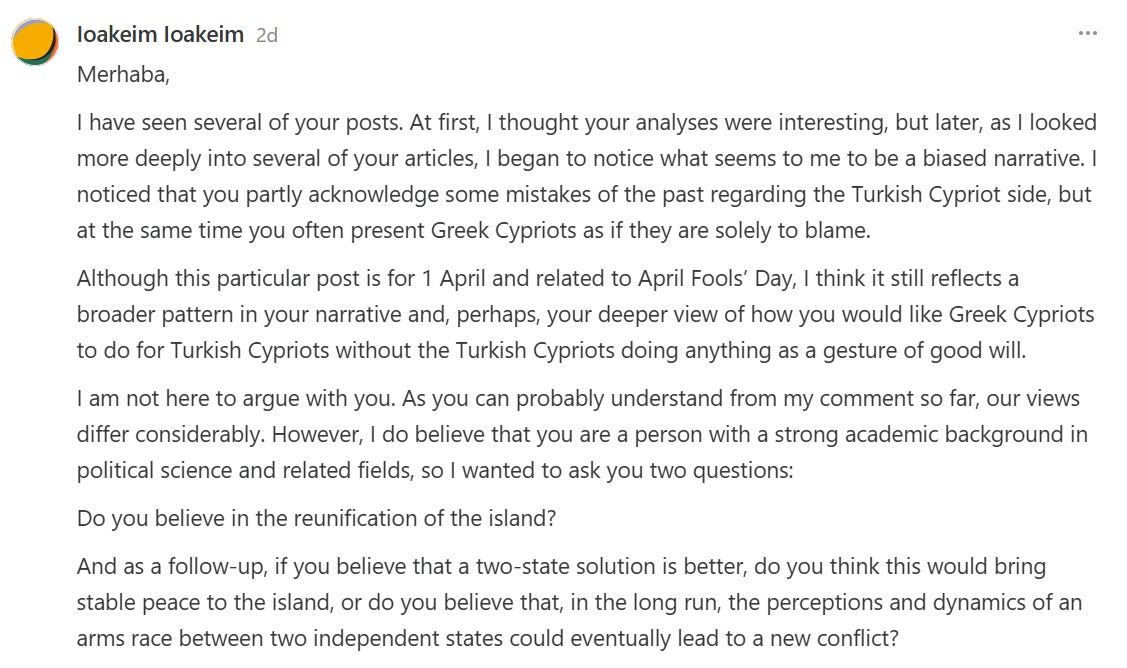
It began with a comment on my post about the Greek and Greek Cypriot leadership’s “historic reversal” (published on 1 April, as a satire of their perpetual refusal to acknowledge reality). Ioakeim Ioakeim wrote:
“Merhaba, I have seen several of your posts. At first, I thought your analyses were interesting, but later, as I looked more deeply into several of your articles, I began to notice what seems to me to be a biased narrative. I noticed that you partly acknowledge some mistakes of the past regarding the Turkish Cypriot side, but at the same time you often present Greek Cypriots as if they are solely to blame.”
This was not a good faith opening. But he was polite. He was measured. He claimed no hostility. He then asked two questions:
Do you believe in the reunification of the island?
If you believe a two-state solution is better, do you think this would bring stable peace, or lead to an arms race and new conflict?
I responded. I told him I did not believe in the “reunification” of a partnership the Greeks / Greek Cypriots destroyed in 1963. I outlined the asymmetry: the Greek / Greek Cypriot side has Greece, the EU, diplomatic acceptance, a military, weapons and hardware from multiple nations, and invasion plans for the TRNC. The Turkish Cypriot side has Türkiye, peace, security, and a demand for political equality. I told him the question was not whether we trust him. It was what he had done - and continued to do - to earn trust. Celebrating EOKA does not help.
He replied:
“Bey Mustafa, although I am tempted to respond to every point you raise, I truly believe that this would eventually turn into a never-ending loop. I am also quite sure that you would agree with that, since both of us, coming from strong academic backgrounds, are aware of different facts and interpretations that can be used to challenge one another.”
This was the first evasion. “Different facts and interpretations.” Not “I dispute your facts.” Not “here is evidence to the contrary.” Just a vague appeal to relativism. He then offered EU federalism as a solution - without addressing why 1963-1974 happened under a power-sharing constitution. He claimed Greeks / Greek Cypriots have “no appetite for a new conflict” while celebrating EOKA and Enosis. He asked me to outline what a two-state solution would look like in practice.
I gave him five points: borders, security, guarantees, movement, political equality. Then I asked him: which of these is unacceptable to you? And why?
He did not answer.
The Retreat: “Different Perceptions of What Counts as a True Fact”
Instead of answering, he retreated further:
“Again, as I told you, I could respond to every point you raise with my own set of facts. However, I am quite sure that both of us have different perceptions of what counts as a true fact and what does not. For that reason, I do not want to get drawn into a fact-checking battle, because it would only turn into an unpleasant keyboard war.”
This is a classic maneuver. When the documented record is against you, claim that “facts” are a matter of perception. He refused a “fact-checking battle” that no one had proposed, because he knew he did not have anything and would lose - a projection of his own avoidance, not a response to anything I had said. He then accused me of “hostility” and “stubbornness,” tone-policing to avoid substance. He invited me for coffee. He implied I was manipulated by Ankara.
I did not take the bait. I thanked him for his tone, but I asked him a series of yes / no questions:
Was there an Akritas Plan? Yes or no.
Were Turkish Cypriots driven from 104 villages between 1963-1974? Yes or no.
Did the UN document “subjugation, if not extermination”? Yes or no.
Does the Greek / Greek Cypriot leadership celebrate EOKA annually? Yes or no.
Do you ever condemn EOKA unreservedly? Yes or no.
I told him: if you cannot answer these with a simple yes or no, the problem is not my “hostility.” The problem is your refusal to accept documented reality.
The Partial Engagement: Concessions That Concede Nothing
He answered. This was more than most do. I acknowledged that. But his answers revealed the core problem.
On the Akritas Plan:
“Indeed, there was the Akritas Plan, and that was one of the major mistakes made by the Greek Cypriot side.”
A “mistake” is what you do when you forget your keys. The Akritas Plan was a blueprint for violent subjugation or extermination. His language minimized.
On the 104 villages:
”The Turkish Cypriots were not driven out by the Greek Cypriots. Rather, following the issue of the 13 points... the Turkish Cypriots chose to withdraw from the government and concentrate themselves in 16 enclaves as a form of protest and self-protection.”
This is false. The UN, ICRC, and British colonial records document forced displacement, not voluntary withdrawal. The 16 enclaves were not chosen. They were what remained after 104 villages were attacked, burned, and ethnically cleansed. He was repeating the standard Greek / Greek Cypriot narrative that erases the violence and reframes displacement as “choice.”
On the UN finding:
“I am sorry, but I am not familiar enough with the third question to give you a proper answer.”
The UN finding is central to the documented record. If he was genuinely unfamiliar, he could not claim to know what happened. If he was feigning ignorance, it was an evasion.
On EOKA:
“Yes, of course we celebrate EOKA, and please do not confuse it with EOKA B. EOKA was a movement against British rule and nothing else.”
This is the heart of the matter. He denied that EOKA targeted Turkish Cypriots as a matter of policy. He claimed there were only “minor attacks” by “some members” acting “on their own.” This is contradicted by Grivas’s own diaries (calling for expulsion / extermination of Turks), British colonial records (documenting systematic attacks on Turkish Cypriot villages in 1956), and the UN record (documenting genocidal intent).
On condemning EOKA unreservedly:
He did not answer. He defended EOKA instead.
The Evidence: What I Provided
I did not simply assert. I provided sources:
UK National Archives FCO 141/4372 (1956 District Reports): documents EOKA murders of Turkish Cypriot civilians in 1955-1956.
UK National Archives, CO 926/1018: Colonial Office report documenting EOKA attacks on Turkish Cypriot villages, including arson and civilian deaths.
UK National Archives, FCO 141/4389: District report from Limassol recording the murder of Turkish Cypriot civilians by EOKA in 1956.
The Times (London), 12 June 1956: Contemporary reporting: “EOKA gunmen killed three Turkish Cypriot civilians in Famagusta district.”
UNFICYP Situation Report, S/5950 (1964): Summarizes pre-1963 violence, attributing initial attacks to EOKA.
Keesing’s Record of World Events, Volume 8 (1955-1956): Documents EOKA’s campaign against Turkish Cypriots from April 1955 onward.
Turkish Cypriot Oral History Archive (EMAA, Cyprus): Survivor testimonies from 1955-1956 attacks.
All of these predate TMT’s formation in 1958.
I challenged him:
“You said EOKA was ‘against British rule and nothing else.’ These documents prove otherwise. Will you read them?”
He said he would. But his subsequent responses suggested otherwise.
The Grivas Problem: One Man or Organizational Policy?
He attempted to dismiss Grivas’s diaries as the writings of one man, not reflective of organizational policy.
I responded: Grivas was the organization’s military leader. His diaries were not private musings - they were operational. He wrote of Turkish Cypriots as “microbes” to be “expelled or exterminated.” British intelligence took him seriously. The UN took the campaign seriously. Why didn’t he?
But I did not stop at Grivas. I named the others:
Grigoris Afxentiou: a killer who targeted Turkish Cypriot villages.
Evangelos Florakis: another EOKA leader who targeted Turkish Cypriots.
Nikos Sampson: the gunman who boasted of killing Turks, later installed as president after the 1974 coup.
Makarios III: the political leader of EOKA, who never condemned its anti-Turkish violence.
I noted EOKA’s pamphlets:
“Death to the Turks. They are seeds to be uprooted.”
I reminded him that EOKA was not an anti-colonial movement. It was a foreign-engineered settler colonial project, one that had been in motion since the late 1800s under British policies to “make Cyprus Greek by migration and taxation” and through “the destruction of Mosques and the mutilation of Turkish Cypriot cemeteries.” It was part of the Greek Cypriot project, the architect and master was Athens, and its target was the native indigenous population - the Turkish Cypriots - as a project that has gone on for one hundred and forty two years.
I offered to print the documents. I offered to read them together. I kept the door open.
The Final Retreat: From History to the Future
He replied:
“Of course, we can continue this historical debate and even work together on a joint archival project for both communities about this period. We could also conduct a comparative study with other cases from around the world during the same time period, which would be even more interesting.”
He did not engage the documents. He offered a vague, future-oriented project instead. He claimed that Greek Cypriots have “learned” and “matured.” He appealed to EU benefits and shared culture. He said there are “radical people” on both sides - a false equivalence between individual extremists and systematic, societally-driven, state-directed genocide.
He wrote:
“The point I am trying to stress is that history is important and we should absolutely study it. But if we remain trapped in it, we will never find a proper solution.”
This is a common evasion. It sounds reasonable. But it is used to avoid looking at the past at all. He wanted “reunification” without accountability. He wanted “coexistence” without acknowledgment of what EOKA was. He wanted “one banner” without explaining why Turkish Cypriots should trust that banner after 1963-1974.
The Closing: What This Conversation Revealed
I responded at length. I chronicled the entire arc of the conversation - his initial politeness, his retreat to “different perceptions of fact,” his partial engagement, his refusal to condemn EOKA, his final retreat to the future. I did so without hostility. I assumed good faith on his part throughout, even as everything in the exchange suggested otherwise. I acknowledged his pretext. But I held him accountable.
I wrote, in part:
“You started by saying I likely hadn’t met or spoken with any Greek Cypriots, yet here we are, the same playbook they repeatedly play being played again by you in similar if not almost identical - yet uniquely ‘you’ and sophisticated through your own design. If irony were made of strawberries, we’d be drinking a lot of smoothies right now.”
I told him the conversation had reached the apex of its usefulness in the context of establishing engagement with the documented evidence. I offered him the last word. I reminded him that the invitation for tea and coffee still stands - but that I would bring the documents, printed, and we would read them together.
He has not responded. Perhaps he will. Perhaps he will read the documents. Perhaps he will not.
But the record of the conversation stands.
Conclusion: The Structure of Denial
This case study is not about one man. It is about a structure.
Ioakeim Ioakeim is not a troll. He is not a liar. He is a sincere Greek / Greek Cypriot who has absorbed the official narrative and cannot step outside it. He concedes small points to appear reasonable. He retreats to politeness when cornered. He appeals to the future when the past is too damning. He offers vague projects instead of engaging with specific documents.
He is, in short, a perfect case study in the structure of denial - denial not as deliberate falsehood, but as a narrative bubble that cannot be pierced by evidence alone.
I did everything I could. I provided documents. I asked yes / no questions. I acknowledged his good faith. I kept the door open. I offered to print the sources and read them together.
He could not walk through. Not because he is malicious. Because the bubble is thick.
But bubbles can be pierced. Not by hostility. Not by rhetorical victory. By patience. By evidence. By repeated, patient, forensic engagement. And by the willingness to meet, not to debate, but to read together.
The tea and coffee invitation still stands. The documents are printed. The summer is coming.
The loop is closed. But the door is open.
All sources cited in this article are available in public archives: UK National Archives (FCO 141/4372, FCO 141/4389, CO 926/1018), UN Digital Library (S/5950, S/6253), and the Turkish Cypriot Oral History Archive (EMAA, Cyprus). Full citations are provided in the main article series.
A note on the conversation: The full exchange is available in the comments section of my original post. I have presented it here in condensed form for readability, but no substantive content has been altered.
My name is Mustafa Niyazi, and I connect the disconnected.


Please do me a solid and like and share, and leave a comment. It helps out big time in the algorithm. Click here or on the button below to subscribe as well for notifications when new articles drop. And read the article below right now. You know you want to.

This research was made possible with the support of this community. Special thanks to my paying subscribers: Birol, Roy, Taşkın, Aydın and Devrim. You are the ones making this happen. Also, a big shout out to those fueling this with teas over at Buymeacoffee, especially Togs. A sincere thank you to all my subscribers - including those who support with their essential free subscriptions. Your commitment to engaging with this work is its foundation. And a massive thank you to those engaging in the vigorous and essential discourse across social platforms. Your support and engagement are deeply appreciated.